Slim. Sculpt. Glow. All Three for $723 $199   Claim Now

EMSCULPT for Athletes: Recovery and Performance Edge
EMSCULPT for Athletes: Recovery and Performance Edge

TL;DR

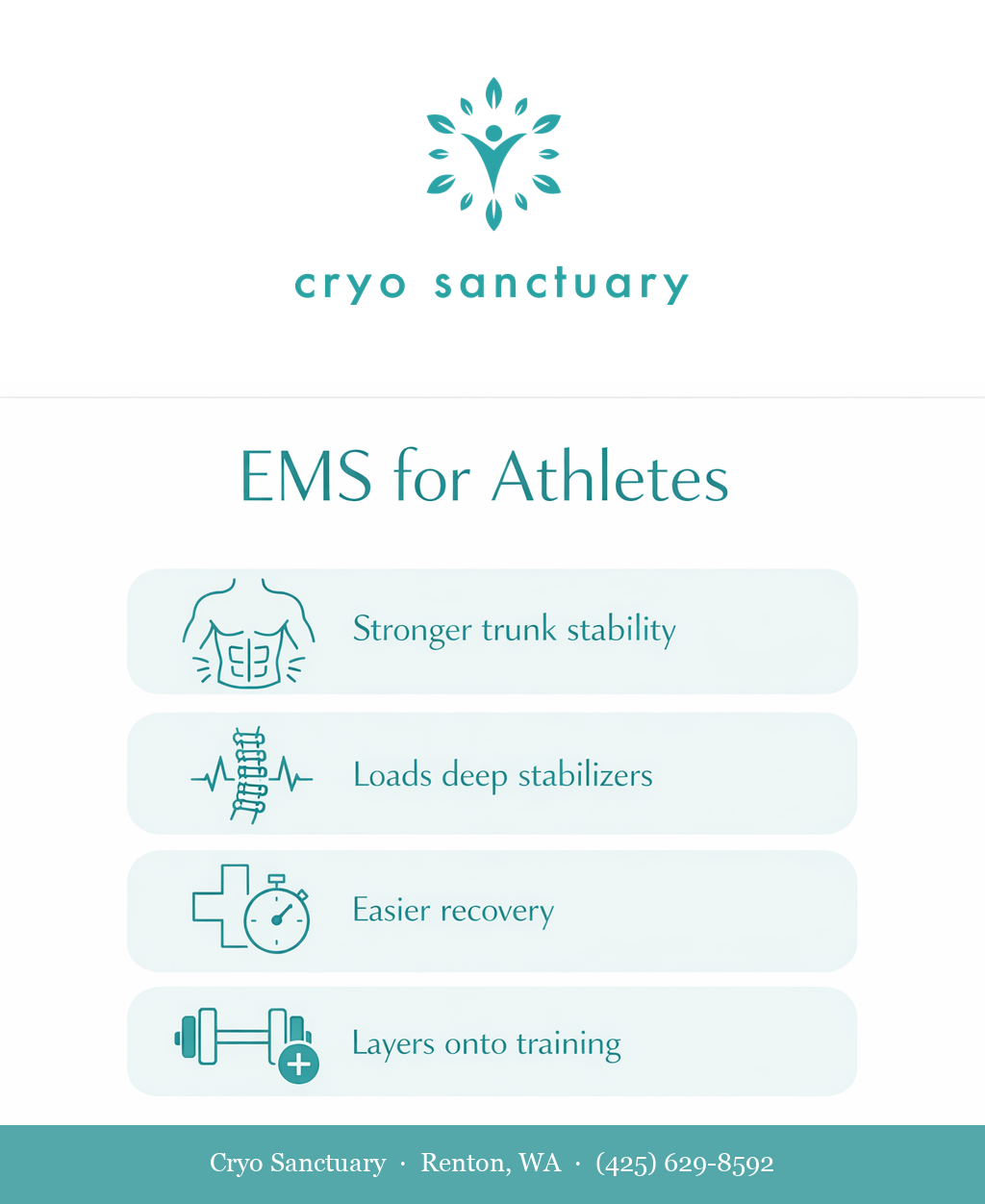
EMSCULPT for athletes uses high-intensity electromagnetic stimulation to trigger thousands of deep muscle contractions per session, mainly to strengthen the core, glutes, and stabilizers that conventional training often underloads. A standard protocol is four 30-minute sessions over two weeks, with most athletes reporting noticeably stronger trunk stability and easier recovery between hard efforts. It is a supplement to training, not a replacement for it, and works best layered onto an existing strength program rather than used on its own.

Table of Contents

What Is EMSCULPT and How Does It Work?

EMSCULPT uses high-intensity focused electromagnetic energy, often shortened to HIFEM, to drive muscle contractions far beyond what you can produce voluntarily. A single 30-minute session triggers roughly 20,000 supramaximal contractions in the targeted muscle group. Your nervous system simply cannot fire a muscle that hard, that many times, in that window on its own.

The result is a deep, fatiguing workload concentrated on one area, most commonly the abdominals, glutes, or, with the right applicator, the calves and arms. Because the device bypasses the usual limits of voluntary effort, it loads the deep stabilizing muscles that tend to get skipped in compound lifts and sport-specific drills.

For athletes, that targeting is the appeal. EMSCULPT for athletes is less about appearance and more about reaching the muscles that quietly govern power transfer, posture under load, and joint protection. To understand how the technology fits alongside other studio modalities, our cryo 101 primer covers the broader toolkit.

Why Athletes Are Adding EMSCULPT to Their Training

Serious training exposes a familiar gap. You can squat, sprint, and lift hard, yet still feel your trunk give out before your legs do, or notice one side stabilizing better than the other. EMSCULPT addresses that gap directly, which is why it has moved from a cosmetic treatment into the recovery and conditioning conversation.

Athletes typically reach for it to:

  • Strengthen the deep corethat braces every heavy lift and explosive movement.
  • Wake up underactive glutes, a common limiter for runners and lifters alike.
  • Address left-right imbalancesby training a specific side without compensating muscles taking over.
  • Add stimulus on a deload or rest daywithout the systemic fatigue of a full lifting session.

It is honest to say the science here is still maturing, and individual response varies. What is consistent is that EMSCULPT delivers a workload to stabilizers that is hard to replicate with bodyweight or light isolation work. See real outcomes in our before and after gallery to set realistic expectations.

EMSCULPT and Recovery: What It Can and Cannot Do

Recovery is where expectations need to stay grounded. EMSCULPT is not a massage, not a cold plunge, and not a passive flush. It is a contraction-based stimulus. So how does it fit recovery?

The contractions promote blood flow to the worked area, and many athletes report less of that deep, hollow core fatigue when their trunk stabilizers are conditioned and resilient. A strong, well-trained core also means better movement quality when you are tired, which indirectly protects you on heavy or high-volume days.

What EMSCULPT will not do: it will not erase soreness from a brutal leg day, will not substitute for sleep and nutrition, and is not a treatment for injury. Pair it with the recovery modalities that actually do flush and calm tissue. Many athletes combine it with cold-based recovery offered in our services menu for a more complete approach: stimulate with EMSCULPT, recover with cold therapy.

The Performance Edge: Core, Power, and Stability

The clearest, most defensible benefit of EMSCULPT for athletes is trunk stability. Nearly every athletic action, throwing, sprinting, changing direction, lifting, depends on a rigid core transferring force between the upper and lower body. A leaky core bleeds power.

Where athletes tend to notice the difference:

  1. Bracing under heavy loads.A conditioned deep core holds tension longer, which can translate to steadier heavy squats and deadlifts.
  2. Rotational power.Golfers, throwers, and racquet-sport athletes rely on a stable trunk to generate and transfer rotational force.
  3. Endurance posture.Distance runners and cyclists hold form longer when the trunk does not fatigue and collapse late in an effort.
  4. Glute engagement.Stronger, more responsive glutes support sprint mechanics and reduce the load that defaults to the lower back.

The realistic framing matters. EMSCULPT builds and conditions muscle you already use; it sharpens an edge rather than handing you a new gear.

EMSCULPT vs Traditional Core Work

EMSCULPT does not replace planks, carries, and anti-rotation work. It complements them by reaching depth and intensity that voluntary effort struggles to match. Here is an honest side-by-side.

FactorEMSCULPTTraditional Core Work
Contraction intensitySupramaximal, ~20,000 per sessionLimited by your own effort
Time per session30 minutes, hands-off15–45 minutes, active
Targets deep stabilizersVery effectivelyVariably, depends on technique
Builds skill and coordinationNoYes
Carryover to sport movementStrength onlyStrength plus motor patterns
Typical protocol4 sessions over 2 weeksOngoing, several times weekly


The takeaway: keep your loaded carries, anti-rotation presses, and compound lifts. Use EMSCULPT to load the stabilizers harder than you otherwise could, then let your sport-specific training convert that strength into skill.

How to Fit EMSCULPT Into a Training Cycle

Timing makes the difference between a useful supplement and a poorly placed stressor. A few practical guidelines:

  • Run the standard block first.Four sessions across two weeks builds the initial conditioning. Many athletes then maintain with one session every two to four weeks.
  • Avoid stacking it before key sessions.Schedule EMSCULPT on lighter or rest days, not the morning of a max-effort lift or a competition.
  • Treat it as adjacent to deloads.A deload week is a natural window to maintain stabilizer conditioning while your main lifts back off.
  • Listen to the targeted area.The deep contractions can leave the worked muscle genuinely fatigued, so give it the same respect you would give a hard training stimulus.

Cost and consistency matter too. Because results come from a series, not a single visit, our packages and payment plans are built to keep a full protocol affordable rather than pushing one-off sessions.

FAQ: EMSCULPT for Athletes

How many EMSCULPT sessions do athletes need?

The standard starting protocol is four 30-minute sessions spaced over about two weeks. After that, many athletes maintain with a single session every two to four weeks depending on goals and training load.

Will EMSCULPT make me bulky or change my weight class?

No. The changes are about conditioning and strength in the targeted stabilizers, not large gains in size. Most athletes use it to feel stronger and more stable, not to add noticeable mass.

Is EMSCULPT a substitute for strength training?

No, and it should not be sold as one. It targets specific muscles intensely, but it does not build coordination, sport skill, or full-body strength. Treat it as a complement to your existing program.

Does EMSCULPT hurt?

It feels like an intense, involuntary muscle contraction with a buzzing sensation, not pain. The intensity is dialed up gradually, and the targeted muscle is usually fatigued afterward, similar to a hard training session.

When will I feel a difference?

Some athletes notice firmer, more responsive stabilizers within a couple of weeks of completing the initial block. As with any conditioning work, the effect builds and fades, so maintenance sessions keep it in place.

EMSCULPT for athletes is best understood as a precision tool: it loads the deep stabilizers harder than willpower allows, then lets your real training turn that strength into performance. If you want to see whether it fits your goals, explore our services or read more on the blog before booking your first block.

Cryo Sanctuary

Author: Cryo Sanctuary

Cryo Sanctuary is a wellness studio in Renton, Washington focused on non-invasive body contouring, targeted cryotherapy, and aesthetic recovery. The studio operates as a single-practitioner practice, which means every session is performed and supervised by the same person from intake to follow-up, with no rotating staff and no franchised technician model. Treatments are delivered on a precision CO2 cryotherapy system holding target tissue at −78°C (−108°F) during slimming and targeted recovery sessions. Services include Cryo Slimming (targeted CO2 fat reduction), EMS Body Sculpting (HIFEM technology comparable to Emsculpt Neo), Cryo Facials, Targeted Cryotherapy for Pain and Recovery, Cryo for Skin Conditions (eczema, psoriasis, acne, dermatitis), and Longevity Shots (NAD+, Sermorelin, B12 MIC). The Before & After gallery features real Cryo Sanctuary clients photographed at the Renton studio, with no stock imagery or staging; typical outcomes documented include 0.5 to 1.5 inches of circumference reduction per treated area over a four-session course. Cryo Sanctuary holds a 4.8+ Google rating with 26+ five-star reviews, was named a 2025 Best of Moss Bay Wellness Center by BusinessRate, and is listed on BBB and Yelp. Services are positioned as wellness care, not a substitute for medical treatment.